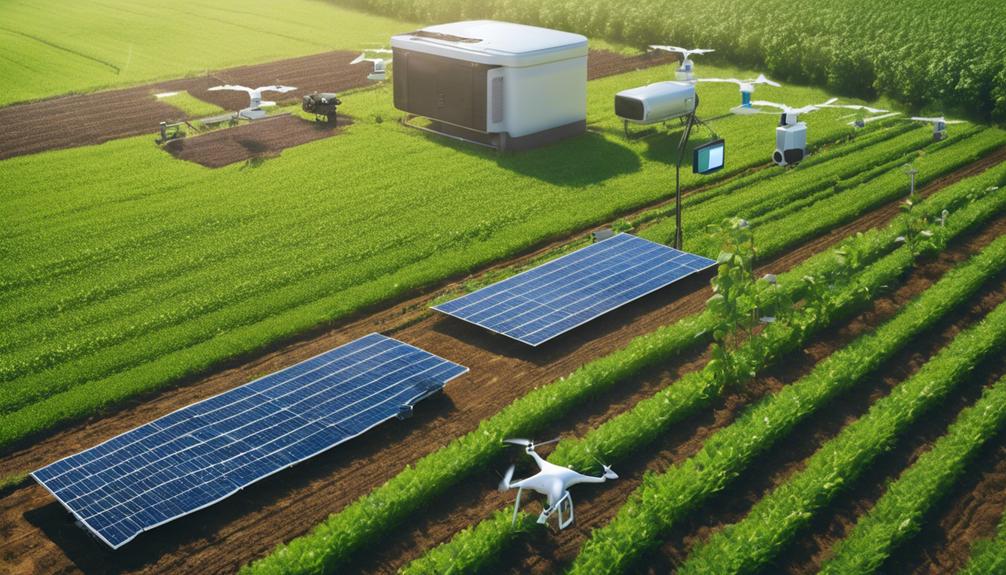
Modern agriculture leverages advanced technologies like precision agriculture techniques, drone technology, IoT sensors, data analytics, robotics, sustainable water management solutions, climate-smart practices, crop monitoring with satellite imaging, and blockchain applications. These innovations enhance sustainability, productivity, and efficiency on farms, promoting environmentally friendly farming practices while boosting crop yields. By embracing tech in agriculture, farmers can optimize resources, monitor crop health, streamline operations, and guarantee food safety. Explore how these innovations are revolutionizing sustainable farming practices for a prosperous agricultural future. Additionally, green tech innovations such as renewable energy-powered irrigation systems and biodegradable crop protection solutions are further transforming agricultural sustainability. These advancements help reduce the environmental footprint of farming while ensuring long-term soil health and biodiversity. By integrating green tech innovations with digital tools, farmers can achieve resilient and eco-friendly food production systems.
Precision Agriculture Techniques
Precision agriculture techniques encompass a range of advanced tools and technologies that enable farmers to optimize their resources and increase efficiency in farming practices. These techniques involve the use of data-driven insights to make informed decisions about crop management, irrigation, fertilization, and pest control. One key aspect of precision agriculture is the use of satellite imagery and GPS technology to create detailed maps of farms. These maps help farmers identify variability in soil types, moisture levels, and crop health, allowing for targeted interventions and optimized resource allocation.
Another important tool in precision agriculture is the use of sensors and IoT devices to collect real-time data on environmental conditions and crop performance. Soil sensors can provide information on moisture levels and nutrient content, enabling farmers to apply water and fertilizers precisely where and when they are needed. Similarly, drones equipped with specialized cameras and sensors can monitor crop health, detect pest infestations, and assess the effectiveness of irrigation systems from above.
Furthermore, precision agriculture techniques also include the use of automated machinery and robotics for planting, harvesting, and other labor-intensive tasks. Autonomous tractors equipped with GPS technology can follow pre-programmed routes with centimeter-level accuracy, reducing overlaps and optimizing field operations. Overall, precision agriculture offers farmers the opportunity to increase productivity, reduce waste, and minimize environmental impact through targeted and data-driven farming practices.
Drone Technology for Farming
Advancing beyond the domain of satellite imagery and soil sensors, drone technology has emerged as a transformative tool in modern agriculture, revolutionizing farming practices with its aerial capabilities. Drones, also known as unmanned aerial vehicles (UAVs), are being increasingly utilized in agriculture for various applications.
One key benefit of drones in farming is their ability to provide farmers with a bird's eye view of their fields. This aerial perspective allows for more efficient crop monitoring, enabling farmers to identify issues such as pest infestations, irrigation problems, or nutrient deficiencies over large areas quickly. By detecting these issues early on, farmers can take targeted actions to mitigate potential crop losses, ultimately enhancing yields and reducing input costs.
Moreover, drones equipped with specialized sensors can capture high-resolution images and collect valuable data on crop health and growth patterns. This data can be further analyzed using advanced algorithms to generate detailed field maps, prescription maps for targeted interventions, or predictive analytics for yield forecasting. Such precision agriculture techniques made possible by drone technology help farmers make informed decisions that optimize resource allocation and improve overall farm productivity.
In addition to crop monitoring and data collection, drones are also used for tasks like aerial spraying of pesticides, fertilizers, or seeds, which can be done with greater precision and efficiency compared to traditional methods. This targeted application of agrochemicals not only reduces environmental impact but also minimizes input wastage, making farming operations more sustainable in the long run.
IoT Sensors in Agriculture
Increasingly, IoT sensors are being integrated into agricultural practices to enhance monitoring and decision-making processes on farms. These sensors play a vital role in modern farming by providing real-time data on various environmental factors, crop conditions, and equipment performance.
One key application of IoT sensors in agriculture is monitoring soil health and moisture levels. By deploying sensors in the soil, farmers can accurately track parameters such as temperature, moisture content, and nutrient levels. This data enables farmers to optimize irrigation schedules, reduce water waste, and make sure that crops receive the nutrients they need for healthy growth.
IoT sensors are also utilized in tracking weather conditions on the farm. By collecting data on temperature, humidity, wind speed, and rainfall, farmers can make informed decisions about planting, harvesting, and pest control. This real-time weather information helps farmers mitigate risks related to extreme weather events and plan their operations more effectively.
Furthermore, IoT sensors are used to monitor livestock health and behavior. By attaching sensors to animals, farmers can track factors like movement patterns, feeding habits, and health indicators. This data allows farmers to detect early signs of illness, optimize feeding regimes, and improve overall animal welfare.
Data Analytics for Crop Management
Data analytics plays a pivotal role in modern crop management practices. By harnessing data, farmers can optimize their yields, predict pest outbreaks, and implement precise irrigation techniques. These advanced analytics tools empower farmers to make informed decisions that promote sustainable farming practices.
Yield Optimization Through Data
In modern agriculture, the utilization of data analytics for crop management has become a pivotal strategy in enhancing yield optimization on farms. Through the analysis of various data points such as weather patterns, soil quality, crop health indicators, and historical yield data, farmers can make informed decisions to maximize their crop production efficiently.
Data analytics allows farmers to identify trends and patterns that may not be apparent through traditional observation methods. By leveraging this technology, farmers can precisely tailor their farming practices, such as irrigation schedules, fertilizer application, and planting times, to optimize crop yield and quality.
Moreover, data analytics enables farmers to monitor the performance of different crop varieties under varying conditions, facilitating the selection of the most suitable crops for specific environmental factors. This targeted approach minimizes risks and maximizes returns, ultimately leading to more sustainable farming practices.
Pest Prediction Models
Utilizing advanced data analytics, farmers can predict and mitigate pest infestations effectively, enhancing crop management practices for sustainable farming. Pest prediction models utilize historical data, weather patterns, soil conditions, and pest behavior to forecast potential infestations accurately. By analyzing this data, farmers can anticipate the best timing for pest control interventions, reducing the need for excessive pesticide use and minimizing environmental impact. By implementing targeted pest management strategies based on predictive analytics, farmers can protect their crops more efficiently while also reducing costs and potential harm to beneficial insects.
Furthermore, pest prediction models can be integrated into precision agriculture systems, allowing for real-time monitoring and decision-making. This proactive approach to pest management not only enhances crop yields but also promotes sustainable farming practices by minimizing the reliance on chemical inputs and promoting ecological balance within agricultural ecosystems.
Precision Irrigation Strategies
Enhancing crop management efficiency, precision irrigation strategies leverage data analytics to optimize water usage and promote sustainable farming practices. By utilizing advanced technology and real-time data analysis, farmers can precisely tailor their irrigation practices to meet the specific needs of crops while conserving water resources. Here are key aspects of precision irrigation strategies:
- Data-Driven Decision Making: Farmers collect data on soil moisture levels, weather forecasts, and crop water requirements to make informed decisions about when and how much to irrigate.
- Variable Rate Irrigation: This technique adjusts the amount of water applied across a field based on variability in soil type, topography, and crop health, ensuring efficient water distribution.
- Irrigation Scheduling: Automated systems use data analytics to schedule irrigation events at the most beneficial times, taking into account factors like plant growth stages and evapotranspiration rates.
- Water Conservation: By delivering water precisely where and when it is needed, precision irrigation minimizes water waste, reduces energy consumption, and supports sustainable agricultural practices.
Robotics and Automation in Farming
The integration of robotics and automation into modern farming practices has revolutionized the agricultural industry, enhancing efficiency and productivity while reducing manual labor requirements. Robots are being used in various agricultural tasks such as planting, weeding, spraying pesticides, and harvesting. These robots are equipped with advanced sensors and software that enable them to perform tasks with precision and accuracy, leading to higher crop yields and reduced resource wastage.
Automation plays an essential role in streamlining farming operations. Automated systems for monitoring soil health, weather conditions, and crop growth help farmers make data-driven decisions in real-time. This leads to optimized resource allocation and improved crop management practices. Additionally, automation in machinery such as tractors and harvesters increases operational speed and accuracy, saving time and labor costs for farmers.
One of the significant advantages of robotics and automation in farming is the reduction of chemical usage. With precise application methods, robots can target specific areas for pesticide or fertilizer application, minimizing environmental impact and promoting sustainable farming practices. Moreover, automation enables farmers to monitor and manage their operations remotely, allowing for greater flexibility and control over their farm activities.
Vertical Farming Innovations
The advancement of vertical farming innovations has introduced new possibilities for sustainable agriculture by redefining traditional farming practices. Vertical farming involves growing crops in vertically stacked layers, often in controlled environments like warehouses or skyscrapers. This method offers numerous benefits such as increased crop yield per square foot, reduced water usage, and year-round production regardless of external weather conditions.
Vertical Farming: Innovations Driving Sustainable Agriculture
- LED Lighting Systems: Energy-efficient LED lights tailored to specific plant needs promote growth and reduce electricity costs compared to traditional lighting.
- Hydroponic Systems: By delivering nutrients directly to the plant roots in a soilless system, hydroponics conserves water and maximizes nutrient uptake, leading to faster growth rates.
- Automated Climate Control: Utilizing sensors and AI, vertical farms can optimize temperature, humidity, and CO2 levels, creating the ideal environment for plant growth while reducing energy consumption.
- Vertical Aeroponics: This innovative system suspends plant roots in the air and mists them with nutrient-rich water, allowing for efficient nutrient absorption and higher crop yields in a compact space.
These advancements in vertical farming are revolutionizing agriculture, offering sustainable solutions to food production challenges in an increasingly urbanized world.
Sustainable Water Management Solutions
Innovative practices in water management are essential for promoting sustainability in agriculture. With water scarcity becoming a growing concern globally, it is vital for farmers to adopt sustainable water management solutions to guarantee efficient use of this precious resource. One such solution is the implementation of drip irrigation systems, which deliver water directly to the roots of plants, minimizing wastage through evaporation or runoff. This method not only conserves water but also promotes higher crop yields by ensuring plants receive adequate hydration.
Another effective strategy for sustainable water management in agriculture is the use of soil moisture sensors. These sensors provide real-time data on soil moisture levels, enabling farmers to irrigate their fields only when necessary. By avoiding overwatering, farmers can prevent waterlogging, nutrient leaching, and ultimately save water and reduce costs.
Furthermore, the adoption of conservation tillage practices can help improve water retention in the soil. By reducing soil disturbance, farmers can enhance the soil's ability to absorb and retain water, especially during periods of drought. Cover cropping is another sustainable water management solution that helps prevent soil erosion, retain moisture, and improve soil health.
Climate-Smart Agriculture Practices
Implementing Climate-Smart Agriculture Practices involves focusing on Soil Health Management and adopting Water Conservation Techniques. By prioritizing soil health, farmers can improve crop productivity and resilience to climate change. Water conservation methods like drip irrigation and rainwater harvesting play a significant role in sustainable farming practices.
Soil Health Management
Effective soil health management practices play an essential role in implementing sustainable and climate-smart agriculture techniques. Maintaining soil health is vital for ensuring ideal crop growth, enhancing resilience to climate change, and promoting long-term agricultural productivity. Here are four key practices for soil health management:
- Cover Cropping: Planting cover crops during off-seasons helps prevent soil erosion, improves soil structure, and enhances nutrient retention.
- Crop Rotation: Rotating crops seasonally helps reduce soil degradation, minimizes pest and disease pressure, and promotes biodiversity within the soil ecosystem.
- Conservation Tillage: Implementing minimal or no-till practices preserves soil structure, reduces carbon emissions, and conserves soil moisture.
- Organic Amendments: Adding organic matter such as compost or manure enriches the soil, enhances microbial activity, and improves nutrient availability for plants.
Water Conservation Techniques
The essential management of water resources is fundamental in sustainable agricultural practices, particularly in the field of climate-smart agriculture. Water conservation techniques play a pivotal role in ensuring the long-term viability of farming operations while mitigating the impacts of climate change on agriculture.
One key water conservation technique is the implementation of drip irrigation systems. These systems deliver water directly to the roots of plants, minimizing evaporation and runoff compared to traditional methods like sprinkler irrigation. Drip irrigation not only conserves water but also promotes higher crop yields by providing plants with the precise amount of water they need.
Another effective water conservation technique is rainwater harvesting. By collecting rainwater from roofs or other surfaces, farmers can store water for later use in irrigation, reducing their reliance on groundwater sources. This practice not only conserves water but also helps to recharge aquifers and maintain water availability in the long run.
Crop Monitoring With Satellite Imaging
How can satellite imaging revolutionize the monitoring of crops in agriculture for enhanced efficiency and productivity? Satellite imaging offers a powerful tool for farmers to monitor their crops with precision and accuracy. By utilizing this technology, farmers can gather valuable insights into crop health, growth patterns, and potential issues that may arise. Here are four key ways in which satellite imaging can benefit crop monitoring:
- Early Detection of Crop Stress: Satellite imaging can detect signs of stress in crops, such as nutrient deficiencies or water scarcity, before they are visible to the naked eye. This early detection allows farmers to take proactive measures to address these issues promptly.
- Optimizing Irrigation Practices: By analyzing satellite imagery, farmers can identify areas of their fields that may be under or over-irrigated. This data enables them to adjust their irrigation practices accordingly, leading to more efficient water usage and improved crop yields.
- Monitoring Crop Health: Satellite imaging provides farmers with detailed information on the health of their crops, allowing them to spot diseases, pests, or other potential threats early on. This proactive monitoring helps farmers implement targeted solutions to protect their crops.
- Yield Prediction: Through satellite imaging, farmers can collect data on crop development and predict yields more accurately. This information is valuable for planning harvest schedules, optimizing resource allocation, and improving overall farm productivity.
Blockchain Applications in Agribusiness
Blockchain technology is revolutionizing agribusiness by enhancing traceability in the supply chain, ensuring transparency for consumers, and enabling secure transactions through smart contracts. With blockchain, every stage of the agricultural process can be recorded and verified, allowing for better quality control and improved trust among stakeholders. The implementation of blockchain applications in agribusiness is paving the way for a more efficient, sustainable, and accountable industry.
Traceability in Supply Chain
Enhancing supply chain traceability in agribusiness through innovative blockchain applications is revolutionizing transparency and accountability in the industry. By leveraging blockchain technology, companies can now track the journey of agricultural products from farm to table with unprecedented accuracy and efficiency. Here are some key benefits of implementing blockchain for traceability in the agribusiness supply chain:
- Immutable Record Keeping: Blockchain allows for the creation of tamper-proof records, ensuring that data related to each stage of the supply chain remains secure and unaltered.
- Real-Time Monitoring: Through blockchain, stakeholders can access real-time information about the location, condition, and handling of products, enabling quick responses to any issues that may arise.
- Enhanced Food Safety: The ability to trace products back to their source helps in identifying and containing food safety incidents promptly, safeguarding public health.
- Building Consumer Trust: Transparent supply chains built on blockchain instill confidence in consumers by providing them with detailed information about the products they purchase, fostering trust and loyalty.
Transparency for Consumers
Revolutionizing consumer trust and confidence in the agribusiness industry, blockchain applications provide unprecedented transparency for consumers regarding the origins and journey of agricultural products. By utilizing blockchain technology, agribusinesses can create immutable, secure, and transparent records of every stage in the supply chain, from farm to table.
Consumers today are increasingly concerned about the authenticity and safety of the food they consume. Blockchain enables them to access real-time information about the products they purchase, including details about the farm where the produce was grown, the methods used in cultivation, transportation, and storage processes. This level of transparency reassures consumers about the quality and sustainability of the food they are buying.
Moreover, blockchain technology allows for quick and efficient tracing of any issues that may arise, such as food contamination or product recalls. This capability not only protects consumers but also helps agribusinesses in maintaining their reputation and fostering long-term relationships built on trust and transparency.
Smart Contracts for Transactions
The integration of smart contracts in agribusiness has streamlined and automated transaction processes, offering efficiency and security in agricultural trade. Smart contracts, powered by blockchain technology, have revolutionized the way agreements are made and executed in the agricultural sector. Here are some key benefits of using smart contracts for transactions:
- Transparency: Smart contracts enhance transparency by providing all parties involved with real-time access to the terms of the agreement and the status of the transaction.
- Efficiency: By automating various steps of the transaction process, smart contracts reduce the need for manual intervention, saving time and resources for both buyers and sellers.
- Security: The decentralized nature of blockchain technology guarantees that transactions are secure and tamper-proof, minimizing the risk of fraud or data manipulation.
- Cost-Effectiveness: Smart contracts eliminate the need for intermediaries, reducing transaction costs and making agricultural trade more cost-effective for all stakeholders involved.
Frequently Asked Questions
How Can Farmers Ensure Data Security With Iot Sensors?
Farmers can guarantee data security with IoT sensors by implementing encryption protocols, using secure communication channels, and regularly updating firmware to patch vulnerabilities. It is crucial to restrict access to sensor networks, use strong authentication methods, and monitor for any unusual activity. Additionally, educating farm workers on cybersecurity best practices can help prevent data breaches. By following these measures, farmers can protect sensitive information collected by IoT sensors from unauthorized access or manipulation.
What Are the Limitations of Using Drones for Farming?
Drones offer numerous benefits in farming, such as precision agriculture and data collection. However, some limitations exist. Factors like weather conditions can affect drone performance, limiting their usability. Regulations and airspace restrictions can also pose challenges for drone operations in agriculture. Additionally, the initial investment in drone technology and the need for skilled operators can be barriers for some farmers looking to utilize drones in their farming practices.
Are There Any Regulations for Using Blockchain in Agriculture?
'To answer the question, it's essential to note that regulations for using blockchain in agriculture are still evolving. As this technology gains traction in the industry, policymakers worldwide are starting to address concerns related to data privacy, security, and interoperability. Keeping these factors in mind, stakeholders must stay informed about the changing landscape and guarantee compliance with existing and upcoming regulations to harness the full potential of blockchain in agriculture.'
How Do Robotics Impact Job Opportunities in Farming?
Robotics in farming have revolutionized traditional agricultural practices by increasing efficiency and productivity. While they reduce the need for manual labor in some repetitive tasks, they also create new opportunities for skilled workers to operate and maintain these advanced machines. Overall, robotics has the potential to transform job roles in farming, requiring a shift towards more specialized technical skills and expertise to harness the benefits of automation in the agricultural sector.
Can Vertical Farming Be Economically Viable in Rural Areas?
Vertical farming can potentially be economically viable in rural areas due to its efficient use of space and resources. By utilizing vertical structures, crops can be grown year-round in a controlled environment, reducing the impact of external factors like weather conditions. Additionally, vertical farming can provide fresh produce locally, reducing transportation costs and promoting sustainability. However, factors such as initial investment costs, energy usage, and market demand need to be carefully considered for long-term viability.